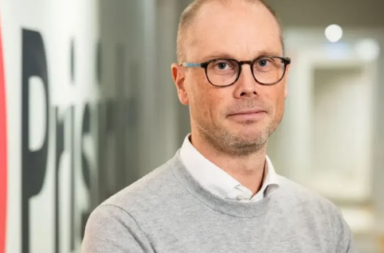
While the autumn has been packed with funding rounds and product launches, one of the more strategically interesting Danish AI stories may have slipped under your radar: Monthio founder Mads Aarup Pedersen has launched Sevren, a European AI lab developing open-source technologies designed to reduce the computing power and memory required to build and run advanced AI models.
Sevren grew out of years of AI research at the fintech company Monthio, which processes large amounts of financial transactions data for customers like Danske Bank. The team, led by Indika Engholm, pushed models to handle large amounts of financial information in very long context windows, and realised the learnings extended far beyond financial services. Monthio has now spun out that foundational work as an independent AI lab.
The company launches with two core technologies. HEIMR is a sparse attention architecture designed to help AI models focus only on the relevant parts of a context, delivering comparable results with less computation and memory, potentially allowing advanced models to run locally on smaller devices with very long context windows. Faberon is a research and optimization engine supporting controlled recursive self-improvement, using AI to test and improve AI methods in repeated, controlled iterations.
“Sevren grew out of years of building AI for real-world financial applications at Monthio. As we pushed the boundaries of what AI could do, for example with our demand for very long context lengths, we realized our learnings extended far beyond financial services. Sevren allows us to focus on developing the technologies behind the next generation of efficient AI while continuing to share our work openly with the wider community,”
said Mads Aarup Pedersen, founder and CEO of Monthio and Sevren.
Computing Backbone on Gefion
Last month, Sevren announced a partnership with DCAI, giving it free access to Gefion, Denmark’s sovereign AI supercomputer, including NVIDIA DGX B300 systems powered by Blackwell Ultra GPUs. The team was live on the infrastructure less than a week after signing the agreement, and early testing on Gefion has already produced promising results: rebuilt open-weight models show significantly improved compute efficiency while maintaining output quality, with results extending beyond language models to fields such as image recognition.
“Sevren’s models must be accessible to everyone. Not just in Denmark, but throughout Europe. Our aim is first and foremost to establish new collaborations in the research community and in business. We are developing new models that shorten the path to AI sovereignty in Europe, but it will only really matter when researchers and companies actually use the technology and help develop it themselves,”
said Mads Aarup Pedersen.
Martin Svensson, CEO of DCAI, called Sevren’s mission one of the central challenges in AI today: getting more value from every unit of compute.
“Technologies that make advanced AI models more efficient can open new possibilities not only for one company, but for researchers, startups, and enterprises across the entire AI community. This is exactly the kind of ambitious innovation Gefion was built to accelerate,”
A Boardroom of Heavy Profiles
The European angle is the case itself. Sevren positions itself in the debate on European AI sovereignty, where access to chips and data center capacity has become a strategic issue. If Europe cannot match the largest American players in raw computing power, the lab’s thesis is that it must compete on efficiency and openness. Faberon is built in part to mitigate the structural disadvantage of limited resources in European sovereign data centers.
Sevren is backed by the same strong team of investor profiles that backed Monthio, which raised € 10 million (75 million DKK) just over two years ago with EIFO contributing 7 million. The angels include Jakob Ekkelund of Templafy, Rikke Kjær Nielsen of EQT, Hans Henrik Hoffmeyer of Coinfy, Glenn Söderholm, formerly of Danske Bank, Klaus Holse, formerly of Simcorp and Tink, Carlsberg CEO Jacob Aarup-Andersen, Peter Hermann of Goldman Sachs, and Peter Rørsgaard of Trifork.
The burden of proof in the field is high. Documented adoption, sustained research output, and credible open-source execution will decide whether Sevren makes a difference in the European AI landscape. But as an attempt to turn Europe’s resource scarcity into a technological advantage rather than another explanation for losing the AI race in advance, the spinout is well worth following.