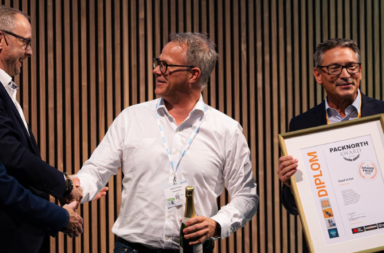
Lund University and Sparbanken Skåne recently awarded this year’s Future Innovation Prize at a big event in Lund, recognizing transformative ideas with the potential to reshape industries and address global challenges. Since its launch in 2017, the prize has celebrated innovations that “change our world for the better,” with a total of € 73,000 (800,000 SEK) distributed among this year’s winners.
A Revolutionary IVF Test Takes Top Prize
The main award went to Yvonne Lundberg Giwercman, a professor at Lund University’s Faculty of Medicine, for developing a patient-specific IVF test that significantly improves fertility treatment outcomes. The test analyzes genetic data to tailor hormone therapies for individual patients—a capability that doesn’t exist today.
“Research shows that women receiving genetically adapted hormone therapy have a 38% higher chance of having a baby compared to those who don’t,”
said Lundberg Giwercman.
The innovation could make IVF treatments more effective and accessible for countless couples struggling with infertility.
A “Methane Detective” for Climate Action
The honorary prize was awarded to Mattias Borg, Johannes Svensson, and Johan Lundgren, senior lecturers in Electromagnetism and Nanoelectronics at Lund University’s Faculty of Engineering. Their team developed an infrared sensor technology that operates at room temperature, eliminating the need for expensive cryogenic cooling (typically below -150°C) required by current systems.
This breakthrough enables large-scale, cost-effective monitoring of methane emissions, a critical tool for combating climate change. Methane, a potent greenhouse gas, contributes significantly to global warming, and reducing its emissions is essential to meeting the 1.5°C global temperature target set by the Paris Agreement. According to the 2021 Global Methane Assessment by the Climate and Clean Air Coalition (CCAC) and UNEP, human-caused methane emissions could be cut by 45% this decade with the right technologies.
“This is an exciting project. Methane emissions have a major climate impact, and addressing them is crucial for achieving global climate goals,”
said jury member Per Hökfelt.
AI-Based Simulation for Robotics and Self-Driving Cars was also highlighted, developed by Adam Tonderski, Georg Hess, and Christoffer Petersson, this innovation enhances the safety and efficiency of autonomous systems.
Student-Led Innovations and a New Award for Established Innovators
Three student projects were also highlighted for their creative solutions:
- Nature-Inspired Airflow for Exercise – Developed by Feiyu Wu, Xingda Li, and Xiaoyue Zhang, this innovation optimizes ventilation during physical activity.
- Grön Tak (Soilless Green Roofs) – Aims to make urban green spaces more feasible and sustainable.
- Smart Wine Labels – Provides transparency on sustainability in winemaking.
In addition to the six winning projects, a newly established prize of € 22,000 (250,000 SEK) was awarded to an experienced innovator whose work has already made a significant impact.